
There’s a phenomenon that’s staring you in the face; it’ll determine your wealth, it’ll shape your quality of life, and it’ll make a deep dent in how you work for the next 20+ years—and nobody’s talking about it.
How to Win in the New Economy
Over the past 150 years, our experience of the world has undergone a seismic shift. Think back to when you got your first cell phone. It wasn’t that long ago, right? Remember TVs with chunky behinds? When digital cameras were mind-blowing? The singsong of dial-up internet? Heck, I remember being floored by my Tamagotchi! All of these advancements happened in the past two decades alone.
Here’s a thought experiment for you.
Think back to a time we all remember all too well—Covid. In 2020, AI existed for most of us in sci-fi books. It was a thing we’d heard of, we could imagine it, but we hadn’t played with it ourselves. It was abstract. Sure, it existed, but not used by the general public, and certainly not to the capability of GPT-4o.
Because of AI, we now live in a time where access to infinite knowledge is faster, cheaper, more globally accessible, and getting smarter every single second. By the time you finish reading this sentence, AI has improved. And now? It’s improved again.
And why this matters to you can be summed up by the most important and urgent words of this essay so far: infinite knowledge.
AI is improving at a rate that our not-so-long-ago-chimp-brains cannot compete with. Not in a hundred lifetimes.
So, what comes next?
I was 900m up a mountain when it hit me. We’re not just in the midst of technological leaps. We’re not just experiencing a mere bump in the road of how we approach education and careers.
We’re entering a new economy. One that nobody is talking about, and very few are prepared for. In this essay, I’ll break down my working theory of ‘the new economy’, and explore the 3 ways you can win in this era.
A Timeline of Economies (and How You Win)
1. The Industrial Economy: You Win When You Fit Into the System
The opportunity to commercially trade beyond your close vicinity meant a surge in demand for people who could meet production quotas. This era was defined by being a cog in the wheel—doing repetitive manual tasks to service a bigger machine.
This was the era of the packing line and the rise of the manager. Much like an engineer would be responsible for keeping a machine going today, managers were responsible for keeping the assembly line churning efficiently.
In the Industrial Economy, you won by fitting in. The vast majority fit into the ‘cog in the wheel’—factory workers, which kept food on the table. The people who won financially figured out that you don’t want to be doing the work, you want to be overseeing the work.
This was a time when education mattered less, and prosperity for most was pretty bleak.
2. The Knowledge Economy: The More You Know, the More You Win
As technology entered its teenage years, humans realized, ‘hey, maybe we can get machines to do all this manual labour?’ But then they asked, ‘okay but how will we spend our days?’ (Note: does this question sound familiar? I think it’s one that we’re re-asking right now…)
This was the era of knowledge. The prestige of a ‘good’ education from a ‘good’ school. The ability to exercise our intelligence by having discipline-specific learning. The deeper you went? The more you were rewarded. For the past ~70 years, our world has been built and shaped by specialists.
The path has been clear: go to school, get good grades, pick a subject, study it at university to a point where you intellectually max out, for the love of all things good do not change your mind(!!) because you’ve just spent 10 years studying this thing, find a job in that discipline, and climb that linear career ladder for the next 50 years until you retire.
Your leverage in this era was your ability to become an expert. Your value and success were intricately linked to how much you knew about stuff. There was a premium placed on commercial intelligence—knowledge in economics, law, and medicine—disciplines that required years, if not decades, to master.
This was often to the detriment of disciplines like art, philosophy, poetry, and music. It’s impossible to know how many gifted creatives swapped the ‘starving artist’ life for ‘corporate America’ because, well, needs must.
I would argue up until 2022, The Knowledge Economy reigned. But then the cracks began to form. We’ve wholeheartedly rejected the ‘commitment at all costs’ mindset of building a career. Challenger universities like the London Interdisciplinary School are gaining traction—where education is based around solving complex problems, rather than mastering specific disciplines.
Furthermore, we’re now of a generation that has experienced relative peace and prosperity our entire lives. We expect work to be varied and challenging. We expect to be respected and have rights. We expect work to be meaningful. Work-life balance is now just table stakes. The thought of doing miserable work for 40 hours a week for the next 50 years feels rather absurd to us.
So when you take these cultural shifts, sprinkle in rapid technological leaps, you have yourself on the brink of a new economy.
3. The Adaptive Economy: Those Who Learn Fast, Adapt, and Apply Expertise Across Domains, Win
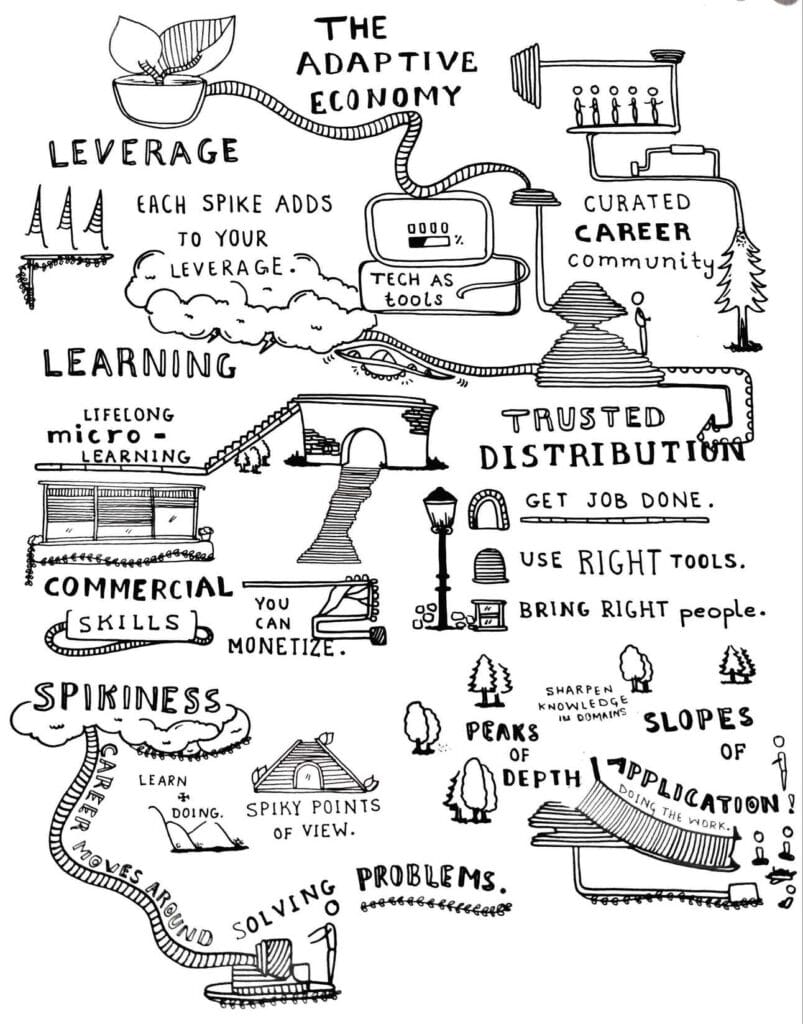
It’s not enough to fit in, or to simply know a lot. In this new economy you win by combining 3 things: Leverage, Learning, and Spikiness.
We quietly entered The Adaptive Economy in 2022. The average half-life of skills is now less than five years, and in some tech fields it’s as low as two and a half years. For millions of workers, upskilling alone won’t be enough. We need to prepare workers to deal with whatever comes down the line, versus upskilling them with specific skills.
So, quick math. The average half-life of skills is now less than five years. If a degree takes 4–6 years, and practical work experience takes another 4–6 years, well, the math ain’t mathing…
You’ll reach redundancy before you reach mastery.
The 3 Ways to Win in the Adaptive Economy
“The Adaptive Economy is an evolution of work whereby the most valuable skills will be leverage, learning and spikiness.”
1. Leverage
Leverage is by definition ‘the action or advantage of using a lever’. A lever is something you can pull that will give you a distinct advantage. The most important levers over the next 20 years will be:
Tools—those who effectively and efficiently use technology as a tool for better work and life outcomes.
Network—those who build strong, deep networks will be more resilient and have access to more opportunities. Verticalised, curated career communities will become as mainstream as belonging to a gym.
Distribution—it’s never been easier to distribute and access information. The people who win in this economy will not be those with the widest distribution (because the barrier to entry is so low), but those who have the most trusted distribution.
Master any one (or a combination!) of these levers as the foundation for your spiky career.
2. Learning
The Knowledge Economy doesn’t disappear, it just changes. Learning will remain an essential trait of successful careers, but it will look different.
Whilst we’ll still have demand for deep, decades-long specialists studying and understanding single domains, the vast majority of the workforce will need to undertake an adaptive approach. Careers will become an evolving, regenerative, life-long learning process of developing commercial competencies (I call these spikes!).
A commercial competency is simply a skill or knowledge that you can monetize. You won’t be the top 0.01%, or be world-class, but you will be good enough to a) get the job done well, b) use tools to get the job done well, c) have enough understanding that you can bring in the right people to get the job done well.
We’ll also see a sharp rise in micro-learning: shorter and more intense periods of education. The metric of an education programme’s success won’t be the length of time you study, but the speed at which you become commercially competent.
3. Spikiness
Spiky careers are made up of intentional peaks of depth followed by slopes of application. Rather than climbing a linear career ladder with a single destination, spiky careerists spend periods (can be many years!) sharpening their depth of knowledge in a domain, discipline or role, followed by a period of meaningful application. If this career were a shape, it might be MWMW.
Spiky careerists cross sectors, industries, domains, and roles. They are not constrained by traditional boxes. They make horizontal, vertical, and diagonal career moves. If they were a piece on a chessboard, they would be the queen. Powerful, because she knows she can move as far as necessary, in any direction.
Careers will be orientated around problems, rather than professions. Perhaps that problem is working on solving the climate crisis, or creating more equitable health outcomes for underserved folks, or increasing access to education. Whatever it may be, this becomes your ‘through-line’. Perhaps one of your spikes sees you tackle it from an analytical lens as a data engineer. And another sees you become deeply involved with research and policy. Before perhaps launching your own venture which leverages all of your past spikes to give you a unique, distinct advantage.
The thing is, when people hear the word ‘generalist’, they assume this is the antithesis of a specialist. A polar opposite. But that definition is outdated. A generalist is an expert learner, problem solver and big picture thinker who can effectively apply these strengths across varied fields and roles. They are skilled at spotting relevant patterns in complexity and are often empathetic and future-focused.
Being a generalist is not being anti-specialist. It’s about stacking your diverse expertise in new and interesting ways.
So, What Comes Next?
There’s a new economy, but the world of work hasn’t caught up.
Many don’t know it yet, but we, the generalists, have been ready for years. We’re experts in stacking diverse expertise and uniquely positioned to solve complex problems in wicked environments. Through education, events, and community, we’re building the workforce of generalist leaders that powers the new economy.
If you’re reading this, and it’s hitting home, you’re early. You’re ahead of the curve. Being early is exciting but it can also feel lonely, frustrating, and kinda painful. My best advice is to surround yourself with people who get it.
You’ll spend 80,000+ hours working. What an absolute, utter, travesty it is to spend one third of your incredibly short time on this earth in a job that makes you miserable.
The Adaptive Economy is here. The question is: are you ready for it?


